
The Can-Do Line · Winter timetable 2026 (stop 1 of 6)
January starts are booked in November: how to plan your 2027 IT consultants now
· All European Careers
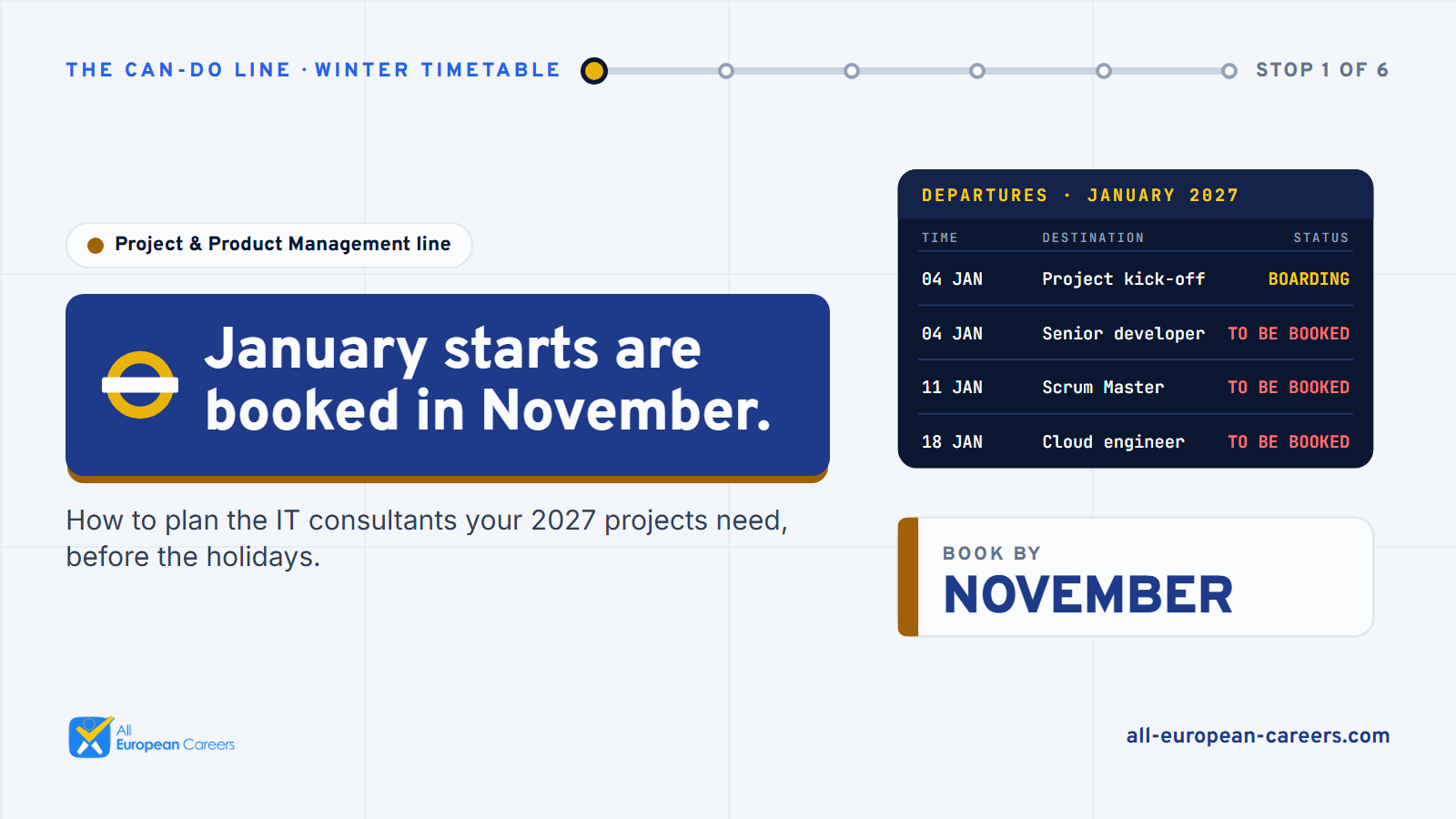
Most 2027 project plans are being signed off right now. Budgets are agreed, kick-off dates are pencilled in for January, and the steering committee is happy. What many of those plans still lack is the people. The kick-off date is real; the consultant who is supposed to be there on day one is still a line in a spreadsheet that says "external resource, TBC".
That gap is easy to close in November. It gets much harder in the second week of January.
Why November is the real deadline for a January start
Work backwards from the first working day of January and the calendar shrinks fast.
Experienced IT consultants usually have to give notice on their current assignment or job. For a freelancer that can be a couple of weeks; for a permanent employee it is often a month or more. Before that notice can be given, they need a signed contract. Before the contract, there are interviews on your side, and before the interviews, a shortlist.
Then add the holidays. Between roughly 20 December and the first week of January, decision makers are away, procurement teams are closed, and the consultants you want are making their own plans for the new year. Anything that is not decided before the break waits until the second half of January.
So a January start is decided in November and signed in early December. That is the window we are in now.
A kick-off date without a named person is a wish, not a plan.
Step 1: Turn "external resource" into a profile
Go through every 2027 project that is approved or close to it and look at each external line. For each one, write down four things:
- The work. What will this person actually do in the first three months? "Java developer" is a job title; "move our payment service from a monolith to Spring Boot microservices" is a brief.
- The skills that decide it. Two or three must-haves, not twelve. Everything else is a nice-to-have.
- The setup. On site, hybrid or remote, and where the work is delivered. This changes who can say yes.
- The frame. Start date, expected duration and whether an extension is likely.
If you can't fill in those four lines, the project is not ready to staff yet, and it is better to know that now.
Step 2: Sort the roles by how hard they are to fill
Not every role needs the same lead time. A rough sort helps:
- Hard to find: specialists in short supply, such as experienced S/4HANA consultants ahead of the SAP ECC maintenance deadline in 2027, SOC and IAM specialists, or anyone with a niche stack. Start these first.
- Hard to time: senior people who are good and in demand. They exist, but they are usually on someone else's project and need notice.
- Easier: common profiles with flexible availability. These can follow in December.
Start the search for the first two groups now. You will not regret a shortlist that arrives early.
Step 3: Decide how you want to work with them
Before you brief anyone, decide what kind of arrangement fits each project:
- A consultant on assignment joins your project for as long as you need them and works under your project lead.
- Team extension puts two or more consultants inside your team, with the supplier handling contracts and changes.
- Project outsourcing hands a defined piece of work, with agreed scope and milestones, to a team the supplier manages.
- Recruitment brings someone onto your own payroll for the long term.
The choice affects who steers the work, how you budget and how quickly you can scale. We go deeper into that choice in a later post in this series. For now, make a first decision per project so your brief is clear. Our services page explains each option.
Step 4: Don't forget the person who keeps the plan on track
Projects that start in January often lack one profile nobody budgeted for: the project manager, Scrum Master or product owner who turns the plan into a working rhythm. If your internal people are stretched across too many 2027 initiatives, an experienced external project manager, Scrum Master or product owner for the first six months can be the difference between a clean start and a slow one.
Step 5: Brief once, early, and ask for a short list
When you brief a supplier, give them the four lines from step 1 and ask for a short list of people they have spoken to, who are available for your start date and who want the role. Three good CVs in the format you need are worth more than fifteen unchecked ones.
Ask two practical questions as well:
- Can the consultant start on the date you need, given their current notice?
- Who will be your contact on the supplier's side once the consultant has started?
The second question matters more than it looks. The start is only the first station. What happens in month three, when the scope changes or something isn't working, depends on whether someone on the supplier's side still knows your project.
A simple timetable for the next six weeks
- Late October: list every external role in approved 2027 projects, with the four lines from step 1.
- Early November: brief suppliers on the hard-to-find and hard-to-time roles.
- Mid to late November: interviews and decisions on the first shortlists.
- Early December: contracts signed, so consultants can give notice before the holidays.
- January: consultants start on day one, with access, equipment and an onboarding plan ready.
It is not complicated. It just has to happen before the break.
How we can help
All European Careers has placed experienced IT consultants on client projects since 2012, in software development, cloud and DevOps, AI and data, SAP and ERP, enterprise applications, business analysis, cybersecurity and project management. We propose people we have spoken to, with CVs in the format you need, and you keep the same contact person on our side for the whole assignment.
Have a project starting in January? Tell us what your project needs and we'll come back with a short list while there is still time to sign before the holidays.