
The Can-Do Line · Winter timetable 2026 (stop 3 of 6)
Your CV is your ticket: how IT consultants get past the gate to the assignment
· All European Careers
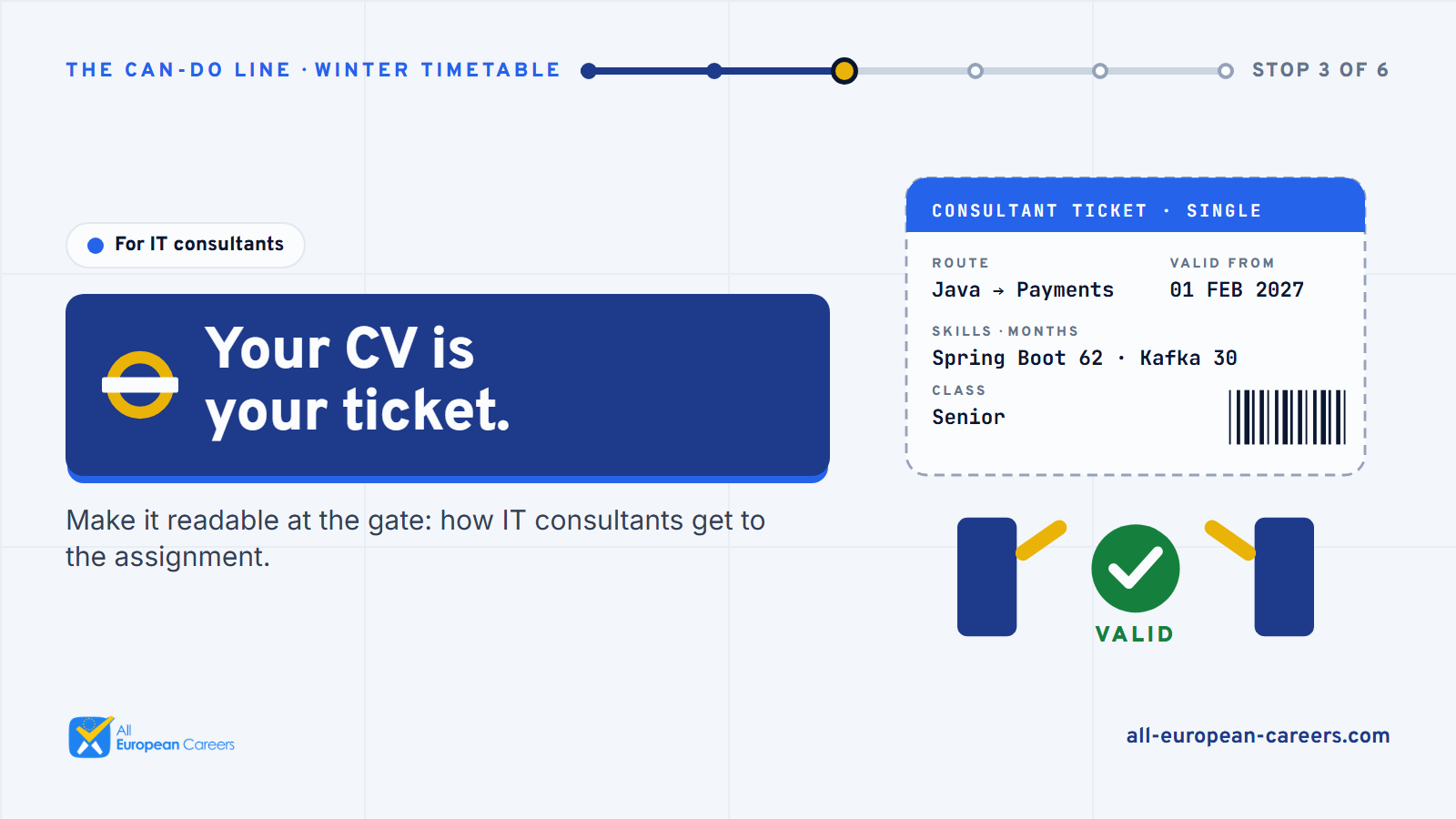
Think of the last time you went through a ticket gate at a station. The gate does not read your life story. It checks a few things quickly: is this ticket valid, for this route, today? If yes, you go through. If not, you stand there.
A consultant's CV works the same way. The person reading it, a delivery manager, a project lead or an evaluator on a tender, has a stack of CVs and a few minutes for each. They are checking a few things: can this person do this work, have they done it before, and are they available when we need them?
Here is how to make your CV pass that check.
Lead with what you did, project by project
A consultant's CV is not a career story. It is a list of projects, and each project should answer the same questions:
- Client or sector (anonymised if you must: "a European bank" is fine).
- Your role, in the words the market uses: "Senior Java developer", not "Engineer III".
- Dates, start and end month, so the reader can count the duration.
- What you did, in two to four lines, with the result where you can.
- Technologies used on this project, listed with the project, not in one big block at the end.
That last point matters more than most people think. When a client needs "five years of Spring Boot", they look for Spring Boot inside the projects and add up the months. A skills block at the bottom that says "Spring Boot: expert" cannot be counted.
Evaluators count months, not adjectives.
Make the months easy to count
Many clients, and nearly every tender for international organisations, score experience in months or years per skill. Help the reader:
- Use month and year for every project start and end (03/2022 to 11/2024).
- Don't double count. If two projects overlap, the same month only counts once.
- Be honest about short projects. A three-month assignment is still experience, and it reads better than a vague "2022 to 2024".
If you have ever had a CV rewritten into a client's template, you will have seen this: the evaluator wants a clean table of months per skill, and they build it from your project list. Make that job easy.
Put the deciding skills where they will be seen
Every brief has two or three skills that decide it. Read the role description and find them. Then check that your CV shows those skills:
- in your headline or summary at the top,
- inside the projects where you actually used them,
- with enough detail to prove depth ("migrated 40 services to Kubernetes on AKS" says more than "Kubernetes").
Do not stretch it. A reader who finds a skill in your summary but in none of your projects will trust the rest of the CV less.
Say when you're available, clearly
The gate checks the date on the ticket. Put your availability at the top: available from a date, notice period, and whether you work on site, hybrid or remote, and where. Many good CVs lose a role simply because the reader assumed the person was not free.
Keep it readable
- Two to four pages is usually enough for an experienced consultant. Older projects can be summarised in one line each.
- Use a simple layout. Clients often copy your text into their own template, and tables inside text boxes do not survive that.
- Use the language of the role. If the client works in English, write in English, even if your mother tongue reads better.
- Send a PDF and keep an editable version ready. Recruiters and clients often need to reformat it.
Check it once more before you send it
Before a CV goes out, read it as the reader would:
- Can I see in ten seconds what this person does and at what level?
- Can I find the two or three skills this role needs, inside real projects?
- Can I count the months?
- Do I know when this person is available?
If the answer to all four is yes, your ticket is valid.
Common questions
Should I write one CV for every role? Keep one complete master CV with every project. For each role, adjust the headline and summary and make sure the deciding skills are visible. Don't rewrite your history; just change what comes first.
Should I include a photo? It depends on the country and the client. Many international clients and tenders don't need one. If a template asks for it, add it; otherwise it is optional.
How far back should I go? Give your last eight to ten years in full, project by project. Older projects can be one line each, unless a role asks for a skill you only used back then.
What about gaps between assignments? Gaps are normal for freelancers. A short line such as "training and certification" or "personal time" is better than stretching dates to hide them.
How we work with consultants
At All European Careers we speak to every consultant before we propose them to a client, and we only put forward people who are available and want the role. When a client needs CVs in a specific format, including tender templates, we prepare that version with you and you check it before it goes out. You get the same contact person through the whole process, and through the assignment.
We place consultants in software development, cloud and DevOps, AI and data, SAP and ERP, enterprise applications, business analysis, cybersecurity and project management.
Looking for your next assignment? See our open jobs or send us your CV and tell us what you're looking for.